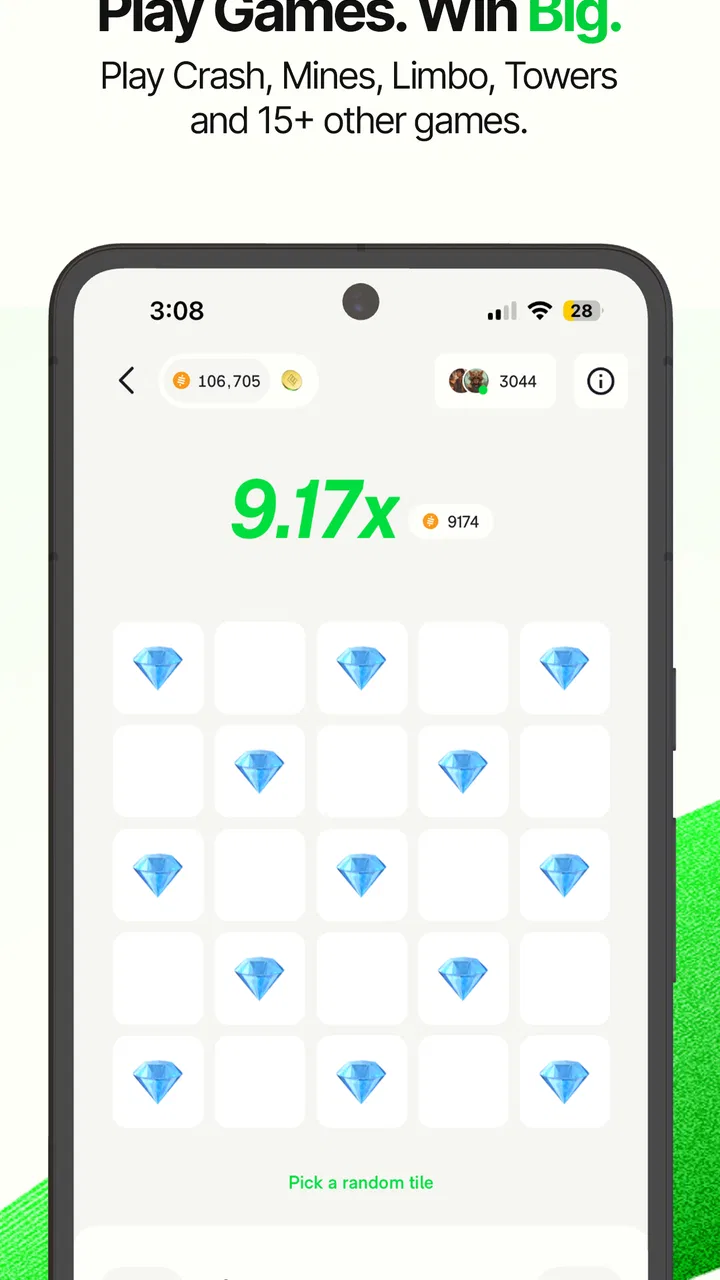
Ember - Play Games. Win Big.
- 4.7
- Rating
- 1.00M
- Installs
- Free
- Price

 Analysis by App-foxy
I approached Ember - Play Games. Win Big. as a finance app with a game-like presentation rather than as a conventional budgeting or banking tool. That distinction matters immediately. Its appeal is aimed at people who enjoy quick, engaging ways to interact with money-related products, while its risks come from treating that entertainment layer too casually. In my experience, the right question is not simply whether it is fun, but whether you can use it while keeping spending, account access, and personal decisions under control.
Ember Fund Inc developed the app, which is free to install and carries a Teen content rating. It has built a sizeable audience, with more than a million installs, a 4.7 average from roughly thirty-seven thousand ratings, and about two thousand seven hundred written reviews. Those figures suggest that many people find the concept approachable, but they do not remove the need to examine how the app fits your own habits. A popular finance app can still be a poor match for someone who dislikes game mechanics around money.
How Ember feels in everyday use
The first thing I noticed is the contrast between its category and its tone. Finance apps usually ask me to think in terms of balances, transactions, budgets, or long-term planning. Ember presents itself around play and the possibility of winning, so the experience feels more immediate and emotionally charged. That can make it easier to open the app during a short break, but it can also encourage decisions based on excitement rather than a calm assessment of what I can afford.
You May Also Like

 Blood Strike: 2.5 Anniversary
Blood Strike’s Loadouts Turn Every Drop Into a Tactical Gamble
A close look at Blood Strike’s custom loadouts: how fast access to signature weapons reshapes its battle royale rhythm, rewards preparation, and narrows the gap between fights.

 Pandora - Music & Podcasts
Pandora’s Music Is Easy to Start, but Harder to Recover
Pandora’s strength is its low-effort path from a seed to a station. Its weak spot is how much confidence it asks you to place in connection, setup, and quiet recovery.

 8 Ball Pool
 Is Built on Rivalries, Rematches, and Routine
A close look at the rivalries, rematches, shared routines, and unanswered safety questions that turn a quick pool match into a persistent mobile community.

 Samsung Music
’s Quiet Strength Is Playing What You Already Own
Its reach comes less from spectacle than from dependable access to a personal library. That simplicity is both the app’s strongest retention engine and its ceiling.

 AccuWeather: Weather Radar
AccuWeather Review: A Quick, Clear Forecast for Everyday Decisions
For everyday plans, the best forecast is the one you can understand quickly. AccuWeather makes rain timing, radar, and local conditions easy to act on, with a few trade-offs.

 Hill Climb Racing
Why Hill Climb Racing Still Turns Crashes Into One More Run
A tiny car, a bumpy hill and one more upgrade: Hill Climb Racing keeps resurfacing because its simple chaos makes every near-miss feel personal.
More From Our News Desk



A realistic example would be someone checking the app after work, intending to spend only a few minutes exploring the available games. The free entry point lowers the barrier, and the playful format can feel less intimidating than a traditional financial product. The danger is allowing a casual session to become a repeated spending habit. I would set a personal limit before using it, rather than deciding how much to spend while already engaged with the app.
That is the central trade-off: Ember is potentially more approachable than a dry finance interface, but it demands more self-awareness. If you want a clear record of bills, automatic budgeting, or detailed household planning, a conventional money-management app is likely a better choice. If you are specifically interested in a game-centered financial experience, Ember has a more relevant purpose.
What the free installation really means
The app is free to download, but it includes in-app purchases ranging from ninety-nine cents to ninety-nine dollars and ninety-nine cents per item. I would treat that range as an important part of the first-use decision, not as a footnote. Free installation does not mean every possible action inside the app is free, so I would review each purchase screen carefully before confirming anything.
On a shared phone or a device used by a younger family member, purchase controls deserve extra attention. The Teen rating makes the app unsuitable for treating money decisions as completely consequence-free, especially when someone else can access the device or payment method. I would use operating-system purchase authentication and avoid leaving a payment method available for one-tap decisions. That is a practical safeguard, not a criticism of the developer.
Another useful habit is to separate entertainment money from essential money. I would never use funds intended for rent, food, transport, debt payments, or emergency savings. Ember works best, if at all, as a tightly limited discretionary activity. Once the money is gone, the session should end rather than becoming a reason to spend more in an attempt to recover it.
Trust starts with visible choices
When I assess a finance app, I look for the choices I can personally control: whether I can avoid purchases, whether I can protect access to the account, whether I can recognize when money is about to leave, and whether the app makes those moments understandable. Ember should be approached through that lens. I would read every permission prompt and purchase confirmation instead of accepting them automatically, and I would pay attention to which choices are optional and which are needed to use a particular part of the service.
I also recommend using a unique password if the app asks you to create an account. A password used nowhere else limits the damage if another service is compromised. Device locking, biometric protection where available, and regular review of account activity are sensible habits for any app connected with money. These steps do not make the app risk-free, but they give the user more agency.
Account control is especially important when an app is designed for frequent, quick sessions. Before committing money, I would identify how to stop, how to sign out, and how to contact support if a transaction looks wrong. I would also keep purchase receipts and check the relevant app-store account after any payment. A few seconds of verification can prevent confusion later.
Where data awareness matters most
Data-sensitive moments usually occur during sign-up, payment, identity-related prompts, and account recovery. I would slow down at each of those points. The app’s finance label makes it tempting to assume that every request is automatically necessary, but a careful user should still distinguish between information needed for a specific function and information requested for broader personalization or communication.
My rule would be simple: provide only what is needed for the feature I am actively trying to use, and read the explanation attached to any permission request. If a prompt is unclear, I would postpone that action rather than approving it just to move forward. I would also review notification settings so that financial messages do not appear where other people can see them.
On a family tablet or a borrowed phone, I would be even more cautious. Shared devices create practical privacy problems even when the app itself behaves properly. Saved accounts, visible notifications, and stored payment details can expose information to the next person using the device. Logging out when appropriate and keeping the device protected are small steps that make the experience safer.
I would not judge trust from the game-like design alone. Bright visuals and quick interactions do not prove that an app is safe, just as a serious-looking interface does not prove the opposite. What matters to me is whether the app gives understandable choices at sensitive moments and whether I can make decisions without feeling rushed. That is where Ember should be evaluated in daily use.
Who will enjoy it, and who should skip it
Ember is a better fit for an adult or responsible Teen who understands the difference between entertainment and financial progress. It may suit someone who wants a short, interactive experience and is comfortable setting strict limits before starting. The free download also makes it easy to inspect the interface without paying immediately, provided you remain alert to the in-app purchase structure.
I would skip it if you are looking for a serious investment dashboard, a personal budget, a bill organizer, or a replacement for a bank account. The game-centered approach is not a substitute for those tools. I would also avoid it if you tend to chase losses, make impulsive purchases, or feel pressure to keep playing after an unsuccessful result. In that situation, the app’s most engaging quality could become its biggest weakness.
Parents should make the decision with the Teen rating in mind rather than assuming that a finance label makes the experience educational. I would discuss spending boundaries before allowing access, protect purchases through the device settings, and make sure the young user understands that “free” and “without financial consequences” are not the same thing.
How it compares with familiar alternatives
Compared with a budgeting app, Ember is more immediate and entertainment-oriented, but it offers a very different kind of value. A budgeting tool helps me understand where money goes and plan upcoming expenses. Ember is built around play, so it is less suitable when my goal is control, forecasting, or financial organization.
Compared with a standard banking app, it should not be treated as the main place to monitor everyday finances. Banking apps are designed around account access and transactions, while Ember’s attraction is the game experience. I would keep those roles separate: use a bank or budget tool for essential money management, and consider Ember only for a limited recreational purpose.
Compared with a conventional casual game, the financial context raises the stakes. In a normal game, an extra purchase may unlock cosmetic content or progress. Here, I would think more carefully before spending because the surrounding theme can make a decision feel more meaningful than it really is. That is why I prefer setting a fixed limit outside the app and treating every purchase as final entertainment spending, not as a strategy for making back money.
Practical ways to keep control
I found that the safest workflow is to decide the rules before opening the app. I would choose a maximum amount, decide how often I am willing to use it, and turn on purchase authentication. Writing the limit down is surprisingly useful because it prevents the app’s mood from changing the decision later.
A second tip is to avoid using Ember when tired, stressed, or trying to recover from a disappointing result. Those are precisely the moments when quick, game-like decisions can feel more attractive. If I notice myself refreshing repeatedly, increasing the amount, or thinking about a previous loss, I would close the app and return only after the impulse has passed.
A third is to review the account and payment trail after using it. I would check the app-store purchase history, keep an eye on bank notifications, and remove stored payment access from a shared device. This creates a simple record and makes unexpected charges easier to spot. It also keeps the app from becoming invisible inside a general monthly statement.
For privacy, I would use the minimum permissions needed for the functions I choose, decline unrelated prompts, and review notifications periodically. I would also update the app through the normal store process. The current version is 38.0 and requires Android 9 or later, so device compatibility is worth checking before installation. On an older phone, I would confirm that the operating system meets that requirement rather than assuming every Android device can run it.
My measured verdict
After considering the design, pricing model, audience, and financial context, I see Ember as a niche app rather than an all-purpose finance recommendation. Its strongest point is accessibility: it offers a game-like way to engage with a money-related product, and the large audience and strong average rating show that the format connects with many users. I can understand why someone would prefer this lively approach to a conventional financial interface.
Its weakness is equally clear. The same immediacy that makes it appealing can make spending feel too easy, especially when in-app purchases reach ninety-nine dollars and ninety-nine cents per item. The app requires active boundaries, careful reading of prompts, and a willingness to walk away. That is more responsibility than I would expect from an ordinary casual game.
My recommendation is cautious and specific: try Ember only with a fixed discretionary limit, protected purchases, and a clear understanding that it is not a replacement for budgeting or banking tools. If you want entertainment with a financial theme and can keep your decisions deliberate, it may be worth exploring. If you need dependable money management or know that game mechanics encourage impulsive spending, choose a traditional finance app instead.
Ember Fund Inc has created an experience that stands apart from standard finance software, and its 4.7 average across roughly thirty-seven thousand ratings indicates real user enthusiasm. I would not let that popularity make the decision for me. The best experience comes from treating the app as optional entertainment, keeping sensitive choices deliberate, and making sure the user—not the excitement of the moment—remains in control.
FAQs for Ember - Play Games. Win Big.
01What is Ember - Play Games. Win Big.?
Ember is a mobile gaming and rewards app that lets users play selected games, complete challenges, and potentially earn prizes or other rewards. The experience generally combines casual gameplay with competitive or promotional features. Before downloading, users should review the current reward terms, available games, eligibility rules, and regional availability, since offers and features may change over time.
02Is Ember - Play Games. Win Big. free to download and use?
The app may be free to download, but that does not necessarily mean every feature is completely free. Some games, contests, entries, or promotional activities may include conditions, optional purchases, or other requirements. We recommend checking the app store listing and Ember’s official terms before participating, especially if a reward or competition requires payment, an entry fee, or personal information.
03Can users really win money or prizes with Ember?
Ember is designed around the possibility of winning rewards through gameplay, challenges, or competitions, but winnings are not guaranteed. Results may depend on skill, rankings, eligibility, contest rules, and the number of participants. Users should read the specific terms for each event carefully, including prize details, withdrawal requirements, taxes, expiration dates, and any restrictions that apply in their country.
04Is Ember - Play Games. Win Big. available in every country?
Availability can vary by location because gaming contests, cash prizes, age requirements, and payment regulations differ between countries and regions. Even if the app appears in your local app store, certain games or reward features may not be accessible where you live. Check the official listing and in-app eligibility information before creating an account or entering any competition.
05What personal information does Ember require?
Like many rewards and gaming platforms, Ember may request account details such as an email address, username, age confirmation, or information needed to process prizes. Additional verification could be required before withdrawals. Review the app’s privacy policy to understand how data is collected, stored, shared, and used. Avoid submitting sensitive information unless it is clearly necessary and handled through official in-app channels.
Pros
- Wide range of games suitable for different playing preferences.
- Clean interface makes browsing games quick and straightforward.
- Promotions and bonuses can increase value for regular players.
- Account features help manage gameplay and personal preferences.
- Available on mobile
- making it convenient for gaming on the go.
Cons
- Real-money gaming may lead to financial losses if played irresponsibly.
- Availability and features can vary depending on your location.
- Some games may require stable internet access to function properly.
- Withdrawal conditions and limits may take time to understand.
- Frequent promotions may encourage users to spend more than planned.

Ember - Play Games. Win Big.
Gallery